The short answer: Scammers are pretending to be computer companies and Medicare to steal money from Florida seniors. If a pop-up, call or text tells you to call a number, let someone into your computer, or "verify" your Medicare number, stop. Hang up and call a number you already trust instead.
Why This Matters Right Now
Florida seniors lost more money to online scams in 2025 than seniors in almost any other state. The FBI's Internet Crime Complaint Center (IC3) says 17,147 Floridians age 60 and older reported fraud last year. Together they lost about $709.8 million. Only California was higher.
Across the country, fake "tech support" scams were the second most common scam reported by people 60 and older. They cost older Americans more than $1 billion in 2025. (Source: FBI IC3 2025 Annual Report.)
Medicare Open Enrollment starts October 15. That is when Medicare scam calls usually pick up, too.
Scam #1: Fake Tech Support
Here is how it usually starts:
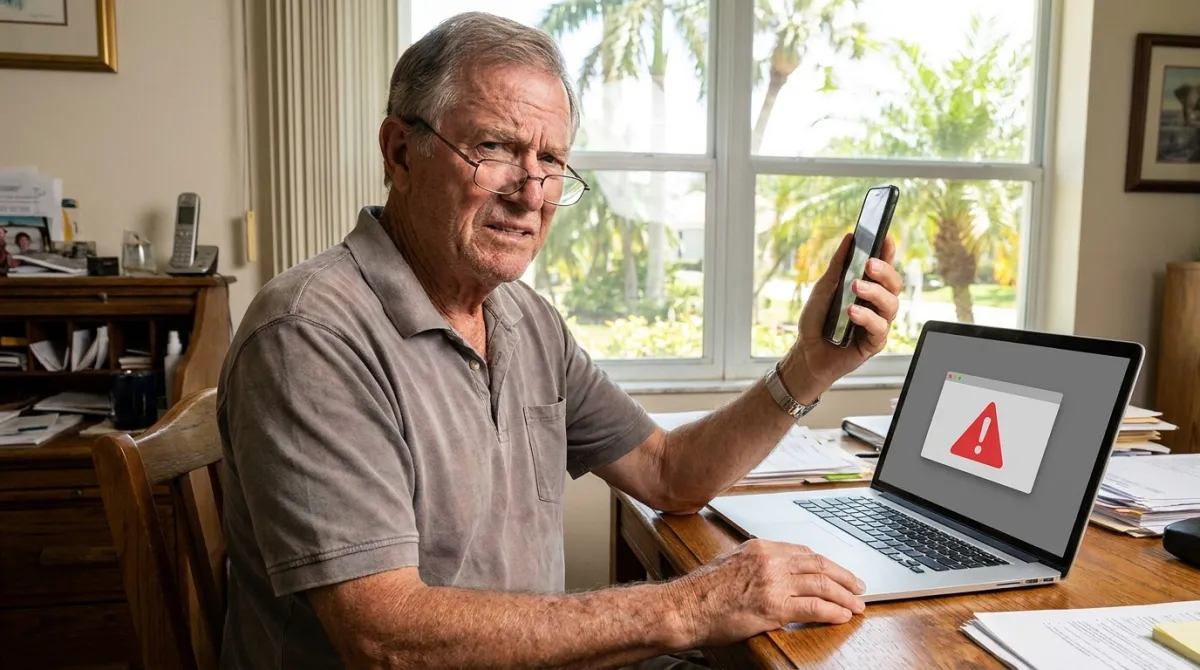
- A loud pop-up covers your computer screen. It says your computer has a virus and tells you to call a number right away.
- Or someone calls you out of the blue saying they are from Microsoft, Apple, your bank or your internet company.
- They ask you to download a program so they can "fix" your computer from far away. This is called remote access. It lets them see and control everything on your screen.
- Then they ask you to pay with gift cards, a wire transfer, cryptocurrency (such as Bitcoin) or a payment app.
Some versions go further. The caller says your bank account has been hacked and you must move your money "to keep it safe." Some even send a courier to your door to pick up cash or gold. The Federal Trade Commission (FTC) says no real government agency or company will ever ask you to do this. (Source: FTC.)
What to Do if You See a Scary Pop-Up
- Do not call the number on the screen.
- Close the browser. If it will not close, turn the computer off and back on.
- If you are still worried, call a family member or a computer shop you already know.
Scam #2: Medicare Season Scams
Medicare will never call you out of the blue to sell you a plan. Medicare will not come to your home. (Source: Medicare.gov.) Watch for these tricks:
- "New Medicare card" calls. A caller offers you a new plastic or "chip" card, and asks you to confirm your Medicare number first. Medicare cards are paper and come in the mail for free.
- Free genetic tests. Someone offers a "free" cheek swab at a health fair, by phone or at your door. They really want your Medicare number so they can bill Medicare. (Source: HHS Office of Inspector General.)
- Free medical equipment. Offers of free braces, catheters or other supplies you did not ask for. Medicare gets billed, and your records may show equipment you never needed.
- Fake caller ID. Scammers can make a call look like it is coming from Medicare or the government.
Only share your Medicare number with your own doctor, pharmacy, insurance plan or someone you called yourself. If you are not sure a letter or card from Medicare is real, call 1-800-MEDICARE (1-800-633-4227).
Want to review your Medicare plan safely this fall? Read our guide to Medicare Open Enrollment 2027 in Florida, or get free, unbiased Medicare help from SHINE.
Scam #3: Texts That Say You Have a Warrant or a Fine
Florida Attorney General James Uthmeier warned this month about scam texts and robocalls, including AI voices and texts claiming there is a warrant for your arrest. A real court will not text you a warrant. (Source: Florida Attorney General.)
New Florida Law on Bitcoin ATMs Starts in 2027
Scammers often tell people to put cash into a cryptocurrency kiosk, sometimes called a Bitcoin ATM. A new Florida law (House Bill 505) will limit how much a person can put into these machines each day. The limit is $2,000 a day for new customers and $10,000 a day for existing customers. Machines will also have to show fraud warnings. The law does not start until January 1, 2027. (Source: Florida Senate.)
Until then, the best rule is simple. No real company, bank or government office will ever ask you to pay with a Bitcoin ATM or gift cards.
Sign Up for Free Florida Scam Alerts
Florida's Department of Elder Affairs runs Operation Senior Shield. It sends free alerts about scams going around Florida. It started in November 2025. (Source: Florida Department of Elder Affairs.)
- Go to opseniorshieldfl.com.
- Fill in your name, email, cell phone number and county.
- Choose how you want alerts: email, text message or voice message. You can pick English, Spanish or Creole.
Adult children can sign up too, so you know what scams your parents may be seeing.
What to Do if You Already Paid or Let Someone In
Act fast. Do not feel ashamed. Scammers fool smart, careful people every day.
- If you gave someone access to your computer: Turn it off. Have a trusted person or shop run a security scan. Change your passwords, starting with email and banking. (Source: FTC.)
- If you paid with a gift card: Call the company that sold the card. Keep the card and receipt.
- If you paid by card, wire or bank transfer: Call your bank or card company right away and ask them to stop or reverse it.
- If you used a Bitcoin ATM: Call the company listed on the machine and ask for a reversal.
- If you mailed cash: Call the U.S. Postal Inspection Service at 1-877-876-2455.
- Report it using the numbers below. Reports help stop the next scam.
Where to Get Free Help
- Florida Attorney General Fraud Hotline: 1-866-9NO-SCAM (1-866-966-7226)
- National Elder Fraud Hotline (U.S. Department of Justice): 1-833-FRAUD-11 (1-833-372-8311), Monday to Friday, 10 a.m. to 6 p.m. Eastern. Staff can help you report and find next steps.
- Florida SHINE (Serving Health Insurance Needs of Elders), Florida's free Medicare help and Senior Medicare Patrol: 1-800-96-ELDER (1-800-963-5337)
- Medicare fraud tips (HHS Office of Inspector General): 1-800-HHS-TIPS (1-800-447-8477)
- Florida Abuse Hotline, if someone is taking advantage of an older or disabled adult: 1-800-96-ABUSE (1-800-962-2873), open 24/7
- Online reports: ReportFraud.ftc.gov and the FBI at ic3.gov
For more ways to stay safe with everyday technology, see our guides on technology for senior independence and home safety for aging in place. If a scam has left you needing legal help, browse elder law attorneys in our Florida senior resource directory.
Disclaimer: This article is for informational purposes only and does not constitute medical, financial, or legal advice. Readers should consult a qualified healthcare provider for medical concerns, a financial advisor for financial planning, and an attorney for legal matters. The resources and programs mentioned are subject to eligibility requirements and availability, which may vary. While we strive for accuracy, the information provided may not reflect the most recent updates. Always verify details with official sources or professionals before making decisions based on this content.